When writing reports, articles, or other publications on specialized topics such as cybersecurity, AI should be integrated into a managed workflow that maintains the credible authority of the author rather than serve as a replacement of the workflow itself. This article explores a potential example of how this can be accomplished.
I. Introduction: The Paradox of AI in Specialized Domains
Since ChatGPT dropped in 2022, there has been a flood of self-represented lawsuits [1], AI-assisted publications to Arxiv (mostly in computer science) [2], open-source software built with AI, AI-focused startups, and so on. Alongside all of that came the less flattering surge of AI-generated misinformation, AI-generated homework submissions, and academic integrity incidents at universities due to AI usage. The common refrain of “this is AI-generated” has done absolutely nothing to slow any of it down. If anything, it has spawned an entire cottage industry of tools specifically designed to make AI-generated content sound more human, albeit with mixed results. TwainGPT exists for exactly that reason. Translation platforms like Kagi now literally offer a “LinkedIn Speak” mode, and at this point, I don’t think I would be wrong for predicting that a significant portion of what shows up in your LinkedIn feed is functionally indistinguishable from the output produced by apps like Kagi.
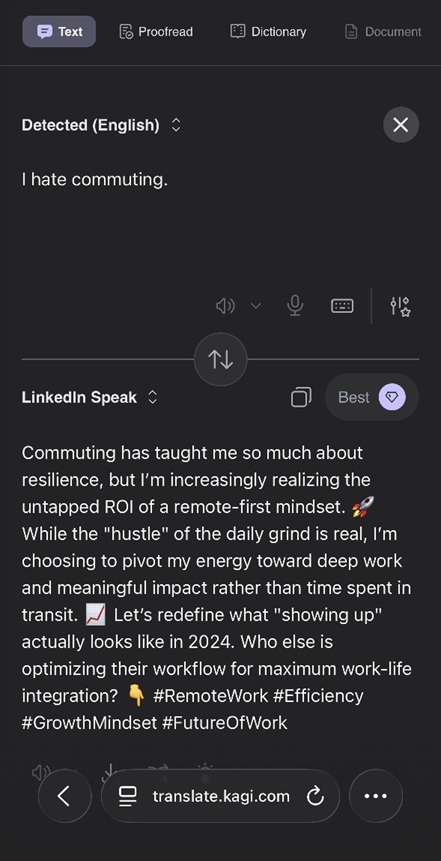
Here is the uncomfortable reality that sits at the center of all of this: for low-stakes, general-purpose writing, such as a LinkedIn snippet that you wouldn’t mind if no one reads, AI is fine. Most people can use it freely and get away with it. But for highly specialized, high-stakes work, like a long-form publication to Arxiv covering a niche sub-discipline of cybersecurity, exclusively relying on AI is a liability. Most deeply specialized fields, including cybersecurity, contain a body of knowledge with a small but conspicuous amount of artifacts that simply aren’t widely published or indexed. If the model you’re using hasn’t been trained on that material, it will hallucinate, and it will do so convincingly, in exactly the place where precision matters most.
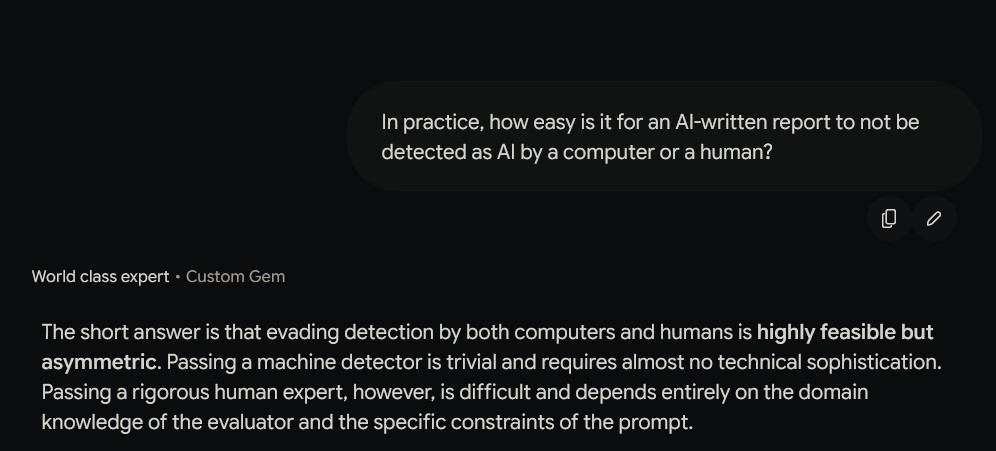
The argument here isn’t that AI has no place in professional writing. The argument is that AI must be integrated into a managed workflow, not used as a wholesale replacement for human authorship. If you fail to do so, you may still be able to evade AI detection by a computer, but certainly not a human who will eventually read your report. Interestingly, if you ask some chatbots questions about how effective AI detection is, they will tell you exactly that.
II. The Core Principle: Why Human Intervention Is Non-Negotiable
There is a specific failure mode that makes pure AI automation dangerous for specialized content, and it is subtler than most people expect. It is not always the obvious hallucination, such as the fabricated statistic or the clearly wrong date. It is the hallucination that sounds entirely plausible. Sometimes the AI describes a mechanism with the right terminology and sources it to a real paper that upon closer inspection doesn’t actually say what the AI claims it says. In a highly technical field, that kind of error can erode credibility fast, and it is the kind of error that a non-expert reader would never catch.
Beyond hallucinations, there is the deeper problem of what AI simply cannot access: proprietary insights, unpublished case studies, real-world operational experience, and the kind of nuanced professional judgment that comes from years inside a specific industry, or even exposure to institutional knowledge that isn’t accessible outside an employer’s enterprise environment. No amount of prompt engineering retrieves what was never in the training data.
This is why the Subject Matter Expert remains non-negotiable in the loop. Contextualizing data within current industry trends, navigating the ethical and legal sensitivities specific to a field, and knowing which sources carry actual authority versus surface-level credibility are not tasks that can be delegated entirely to a model. AI can accelerate the process considerably. It cannot replace the expertise that gives the final product its credibility.
The following section of this blog post describes a managed workflow in which AI could be integrated into report writing for specialized topics.
III. The Blueprint: A Managed Workflow for AI Integration
Phase 1 — Ideation and Strategic Intent (Human-Driven, No AI Yet)
This step involves no AI at all. The work here is purely human: decide what you are writing, define your intended audience, and articulate the key points you want to make before you touch a single tool [3]. This pre-drafting architecture matters more than many writers give it credit for. The clearer your scope and audience profile at this stage, the more useful every subsequent AI interaction becomes. Feeding an AI a vague starting point produces vague output. Come in with specificity.
Phase 2 — First Draft (Raw Thought Capture)
Whether AI enters at this stage depends entirely on your relationship to the topic. If you are writing about something you know relatively little about, research comes first. Gemini is well-suited for pulling from authoritative sources within a given industry [4]. Claude, on the other hand, is better positioned for extracting and synthesizing the core arguments from those sources once you have them in front of you [5].
If you are writing about something you know deeply and you want to lead with your own perspective, skip the research for now and go straight to raw thought capture [3]. Personally, I prefer to dictate my thoughts on the fly, especially if I am worried that I will forget my ideas or I need will write my thoughts at different times of the day. One tool that has been genuinely useful for me, and that I strongly recommend, is Wispr Flow. It handles voice dictation and transcription well, which matters when I don’t have a physical keyboard in front of me, or if I care about a higher WPM (words per minute) rate than standard typing. I have never been a big fan of typing on the phone for this reason. The goal at this stage is capturing the substance of your thinking, not polishing it.
Phase 3 — Synthesis and Structuring
Take what you produced in Phase 2 and use ChatGPT or Gemini to build an outline from it. Both are strong at classifying and organizing text, and either will do a reasonable job of structuring your raw material into something with a coherent logic. Define your intended tone in the prompt, be it professional, strategic, casual, or whatever fits the context and audience. An example prompt for Gemini at this stage might look like this:
“Gemini, please organize the following key points of a draft LinkedIn article into an outline that is specifically tailored to an audience consisting of CISOs and CIOs. Make the tone strategic and professional. [key point 1] [key point 2] … [key point n]"
One important step before moving forward: review the outline the AI returns and check whether any of your original key points got dropped in the reorganization. It happens more often than you would expect. The outline may also surface gaps in your initial draft or sections that clearly need additional content to hold up.
Phase 4 — Augmented Deep Research (Optional)
This phase is specifically for writers who started from existing expertise in Phase 2 rather than external research. Even when writing from deep knowledge, it is worth conducting targeted research after the fact to verify your claims against the existing literature, particularly for any areas where you may have relied on memory over precision.
If your topic is backed by quantitative data, court rulings, or regulatory frameworks, this is the stage to bring that in. Gemini handles real-time web browsing well for up-to-date sourcing. ChatGPT can be more useful when the task is summarizing or parsing dense legal or regulatory documents. The outline generated in Phase 3 will often make it obvious which sections need this treatment, which are the ones making claims that require data to support them will stand out.
Phase 5 — Narrative Drafting
This is where the report takes shape. Take the raw draft from Phase 2 and feed it to Claude, structured around the outline from Phase 3. Claude is the right tool for this step specifically because it handles long-form writing with a consistent cadence and natural flow better than the alternatives [4]. It is also built to treat clipboard-pasted content, such as links, images, and text snippets, as distinct entities from the prompt itself, which is useful when you are working with multiple sources at once.
A prompt that tends to work well at this stage:
“Claude, please generate an organized report based on the sections of my article regarding AI usage in specialized reports that are defined in the attached outline. Use the attached transcript as a guide for tone and voice, along with the attached links to each of the sources I want cited. Make sure to preserve the conversational authority of the original transcript and vary the sentence structure as well."
The output at this stage will be significantly more organized than your Phase 2 draft. It will also likely still carry some AI elements that need to be removed, which is exactly what the next phase is for.
IV. The Safeguard: Human-Led Verification and Polishing
The Technical Audit
The first thing to check in any AI-generated draft is the sources. This is a pattern that shows up consistently: when an AI is asked about a highly specialized subject, it will frequently cite a real source but misrepresent what that source actually says. Open the links. Read the relevant sections. If the AI attributed a claim to a source that doesn’t support it, correct it immediately rather than letting it carry through to publication. Regulatory citations, statistical figures, and quoted frameworks deserve particular scrutiny.
Voice, Specificity, and Flow
Once the sourcing is clean, the focus shifts to humanization [3]. The most effective method is not to go through the draft looking for AI-sounding sentences to delete. It is to go through looking for places where personal specificity can be injected. A professional observation from your own practice. A real case you worked. A cultural aspect that only your audience would draw. These are the things that AI cannot fabricate convincingly, and they are the things that make a report worth reading.
You may also notice, in a draft that came through an AI, a kind of rhythmic uniformity, be it from paragraphs of similar length or sentences that follow predictable patterns. Breaking that up is worth the effort. Merge paragraphs where it makes sense. Split others. Vary the cadence deliberately. Similarly, if you spot any generic buzzwords that could be replaced with more precise, industry-specific language, then replace the buzzwords. It further hones your writing towards a specific audience rather than a general readership.
Once those edits are complete, do a final proofread from start to finish. By that point, the report should be functionally indistinguishable from something written entirely by hand.
V. Conclusion: The Strategic Value of the Hybrid Approach
The competitive advantage of this workflow is not speed alone, but rather the combination of speed with technical credibility. An AI-only report can be produced faster, but it carries real risks in specialized domains that can undermine the authority of the person publishing it. A fully manual report preserves that authority but sacrifices the efficiency that AI genuinely offers.
The hybrid approach, where AI handles structural scaffolding and drafting acceleration while the domain expert maintains control over accuracy, sourcing, and voice, delivers both. It is faster than writing entirely from scratch. It is more reliable than handing the task to a model without supervision [6]. It is the most useful when you are balancing multiple tasks, especially ones with competing deadlines.
The bottom line: AI can power the engine. For high-stakes, specialized content, the domain expert has to stay in the driver’s seat.
This entire blog post was written by following the exact workflow described above, including the steps that required human intervention. Were you able to tell? I invite your feedback!
Sources
[1] Absurd AI-Powered Lawsuits Are Causing Chaos in Courts, Attorneys Say, “Clogging the System” and Driving Up Costs - https://futurism.com/artificial-intelligence/ai-lawsuits-chaos-courts-lawyers
[2] Ai-generated Research Papers Published On Arxiv Post Chatgpt Launch - https://originality.ai/blog/ai-generated-research-papers
[3] AI LinkedIn Posts: How to Use AI Without Sounding Like AI — https://magicpost.in/blog/ai-linkedin-posts
[4] ChatGPT vs Claude vs Gemini for Content Creation 2026 — https://miraflow.ai/blog/chatgpt-vs-claude-vs-gemini-content-creation-2026
[5] AI Chatbot Comparison: DeepSeek vs Gemini vs ChatGPT vs Claude — https://softices.com/blogs/ai-chatbot-comparison-deepseek-chatgpt-gemini-claude
[6] How to Strike the Right Balance Between AI-Driven Content and Human Touch — https://elearningindustry.com/how-to-strike-the-right-balance-between-ai-driven-content-and-human-touch